

Carne Asada Recipe (Step-by-Step Guide)
In my family, carne asada is not a recipe. It is an event.
I figured this out as a child at my tío Ernesto’s house in El Paso, where a backyard gathering in summer was signaled three houses down by the smell alone — charcoal smoke, sizzling beef, the faint sweetness of charred green onions. By the time we arrived, Ernesto would already be at the grill, a beer in one hand and a pair of tongs in the other, holding court over skirt steak that had been marinating since the night before. Neighbors appeared. Cousins multiplied. Someone brought horchata. Someone else brought a botana tray of jicama and chili-lime seasoning. Nobody formally announced that a party was happening — the smoke did that.
That’s the thing about carne asada that gets lost in translation when it travels north and ends up on a chain restaurant menu: it’s not just a preparation, it’s a social institution. In Northern Mexico — in Sonora, Chihuahua, Baja California, Nuevo León — tener una carne asada (to have a carne asada) means to host. The grill is the gathering point. The food is the reason. And the definition of that food is precise: thinly sliced or chopped skirt steak, marinated in citrus and fresh herbs, grilled over screaming-hot direct heat until charred and smoky outside and just barely pink inside, then served on small doubled-up corn tortillas with nothing more than raw white onion, cilantro, salsa verde, and a hard squeeze of lime.
You’ve probably eaten something called carne asada that was dry, underseasoned, and cut too thick. I’m sorry. That’s not what we’re making here. Fire up the grill.
Recipe at a Glance
• Prep time: 15 minutes (plus 2–8 hours marinating)
• Cook time: 10 minutes
• Total time: 25 minutes active, plus marinade time
• Difficulty: Beginner
• Yield: 6–8 servings
• Course: Main / Taco filling / Street food
• Region/Origin: Northern Mexico (Sonora, Chihuahua, Baja California)


Ingredients
For the Marinade
• Juice of 3 limes (about ¼ cup / 60 ml)
• Juice of 1 orange (about ¼ cup / 60 ml)
• 4 garlic cloves, minced or pressed
• ½ white onion, roughly chopped or grated
• 1 cup (40 g) fresh cilantro, roughly chopped (stems and leaves)
• 1–2 jalapeños or serranos, roughly chopped
• 1 teaspoon (3 g) ground cumin
• 1 teaspoon (6 g) kosher salt
• ½ teaspoon (1 g) black pepper
• 2 tablespoons (30 ml) white vinegar
• Optional: 2 tablespoons (30 ml) soy sauce — debated but widely used in Sonoran and Tijuana-style carne asada for umami depth
For the Meat
• 2–3 lbs (900 g – 1.4 kg) outside skirt steak — the ideal cut (see notes)
For the Grill
• Oil for grates
• Whole jalapeños and green onions (cebollitas) for grilling alongside
For Serving (Tacos)
• 12 small corn tortillas (4–5 inch / 10–13 cm), doubled up
• Diced raw white onion
• Chopped fresh cilantro
• Salsa verde or tomatillo salsa
• Lime wedges
• Guacamole or sliced avocado
• Sliced radishes
Ingredient notes:
• Outside skirt steak: The gold standard for carne asada — intensely beefy in flavor, thin enough to cook fast, and it takes a char beautifully. Inside skirt steak is a good second choice. Flank steak is leaner and more widely available but less flavorful; it works fine. Avoid sirloin, ribeye, or chuck — wrong texture and wrong fat distribution for this application.
• Citrus marinade: The lime and orange acids tenderize while adding brightness. Do not marinate for more than 8 hours — the acid begins to chemically “cook” the surface of the meat, giving it an unpleasant mealy texture.
• Fresh cilantro in the marinade: Essential for the Northern Mexican flavor profile. The cilantro blooms in the marinade and the grassy, herbal quality carries through to the finished, charred meat. Don’t skip it.
• Soy sauce: The addition of soy sauce to carne asada marinades is common in Sonoran and Tijuana home cooking — it adds a savory umami depth and helps the meat develop a better crust on the grill. It’s a personal choice. Use it or don’t; both are legitimate.
We offer catering services in and around Austin, TX and Texas Hill Country. Inquire HERE.
Step-by-Step Instructions
1. Make the marinade. Combine all marinade ingredients in a bowl and whisk together. Alternatively, pulse briefly in a blender for a slightly smoother consistency that coats the meat more evenly.
2. Marinate the steak. Place the skirt steak in a large zip-lock bag or shallow baking dish. Pour the marinade over, turning to coat all surfaces. Seal and refrigerate. Minimum: 2 hours. Ideal: 4–6 hours. Maximum: 8 hours. Don’t go longer.
3. Prep for the grill. Remove the steak from the refrigerator 30 minutes before grilling so it can approach room temperature. Pat the surface lightly — but don’t remove all the marinade. Some of those herbs and aromatics clinging to the surface will char beautifully on the grill.
4. Get the grill screaming hot. This is the most important step. Carne asada requires direct, intense heat — the kind that sears and chars on contact. For charcoal: fill a chimney starter and let coals go fully white before spreading them under the grates — you’ll know they’re ready when they glow orange-white and the air above shimmers with heat. For gas: preheat on high for at least 10 minutes with the lid closed. Oil the grates lightly to prevent sticking.
5. Grill the steak. Lay the skirt steak directly over the highest heat. Grill 3–5 minutes per side, depending on thickness. You want visible char marks and a slightly blackened crust — listen for the aggressive sizzle the moment the meat hits the grates, and smell for that first rush of char and caramelized marinade. Skirt steak is thin — resist the urge to flip repeatedly. Two flips, maximum.
6. Rest the meat. Transfer the cooked steak to a cutting board and rest for 5 full minutes. Do not skip this. Cutting immediately releases all the juices onto the board instead of the taco.
7. Slice and chop. Identify the grain of the skirt steak (the direction the muscle fibers run — they’re very visible in this cut). Slice against the grain into thin strips, then give those strips a rough chop. This is the traditional cut for taco filling — smaller pieces that nestle into a small tortilla without sliding out.
8. Grill the accompaniments and tortillas. While the steak rests, lay whole jalapeños, green onions, and corn tortillas directly on the hot grates. Char the jalapeños until blackened and blistered. Let the green onions soften and caramelize. Grill the tortillas for 30–45 seconds per side until they have char marks and are heated through.
9. Build the tacos and serve. Double-stack two corn tortillas (the traditional way — one tortilla is never enough for a saucy taco). Pile on the chopped carne asada. Add diced white onion, fresh cilantro, a spoonful of salsa verde, and a hard squeeze of lime. Serve everything directly from the grill. This dish does not wait. Critical technique tips: - High heat is not optional. Carne asada grilled over medium heat will steam rather than sear. The Maillard reaction — the chemical browning that creates that smoky, charred crust — requires high, direct heat. If the meat doesn’t sizzle the moment it touches the grates, the grill isn’t ready.
• Always slice against the grain. Skirt steak has long, prominent muscle fibers. Cutting with the grain makes it chewy; cutting against shortens those fibers and makes each bite tender.
• Rest before slicing. Five minutes. It makes a real difference.
• Charcoal adds dimension. Charcoal produces a smoky flavor that gas cannot fully replicate. If you have the option, use it. Mesquite charcoal is particularly traditional in Northern Mexico and Texas.
Tips, Variations & Substitutions
Regional Variations
• Sonora-style (the purist approach): Minimal marinade — salt, pepper, and lime only. Extremely high heat. The philosophy here is that good beef needs nothing but fire. Sonora is one of Mexico’s finest beef-producing states, so the quality of the meat carries the dish.
• Baja/Tijuana-style: Longer citrus marinade, soy sauce common, sometimes served in flour tortillas rather than corn — a distinction that reflects Baja’s proximity to U.S. border food culture.
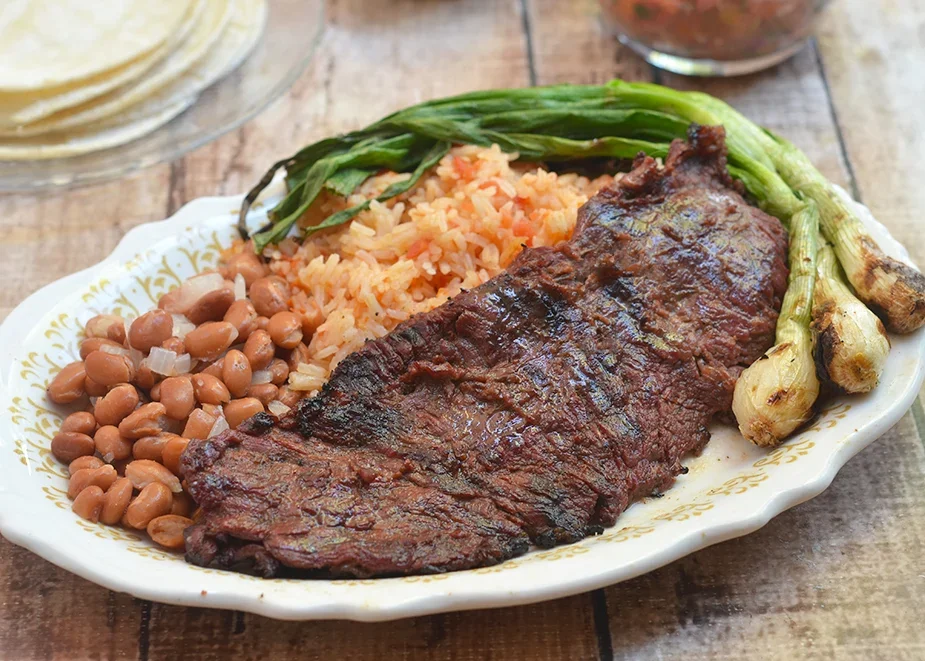
• Texas/border style: Thicker cuts sometimes used; often served as a platter with flour tortillas, refried beans, rice, and pico de gallo rather than as individual tacos.
• Norteño street style: The purest taquería presentation — small corn tortillas, a spoonful of salsa verde, raw onion, and cilantro only. Nothing else. This is the form.
Spice Level Adjustments
The meat itself carries zero heat. All spice comes from the accompaniments. - Mild: Serve with fresh pico de gallo only. - Medium: Roasted tomatillo salsa (salsa verde). - Hot: Salsa de árbol or grilled whole serranos alongside.
Dietary Adaptations
• Gluten-free: Naturally gluten-free with corn tortillas (and without soy sauce in the marinade).
• Lighter option: Flank steak is leaner than skirt; same preparation, slightly less fat.
• Bowl format: Slice the carne asada over white rice or chopped romaine with guacamole and pico de gallo for a tortilla-free option that still hits all the right notes.
How to Serve Carne Asada
The traditional taco setup is sacred: small doubled-up corn tortillas, chopped carne asada, raw diced white onion, fresh cilantro, a spoonful of salsa verde, and lime. That’s all you need. Resist the urge to pile on. The simplicity is the point.
For a full spread, add: - Grilled jalapeños and cebollitas (green onions) alongside the meat - Refried beans and Mexican rice for a complete platter - Guacamole or sliced avocado - A small bowl of salsa roja alongside the salsa verde - Ice-cold drinks — agua de jamaica (hibiscus water) is the classic pairing
For presentation: pile the sliced and chopped carne asada on a wooden board or platter. Arrange the grilled jalapeños and green onions around the meat. Set out all the toppings in small bowls and let guests build their own tacos. This is not a dish you plate in the kitchen — it belongs at the table, in the middle, shared.
The Story Behind Carne Asada
Grilling beef over an open fire is as old as humanity. But carne asada as a cultural institution — as a ceremony — belongs to Northern Mexico. According to food historians cited by the BBC, the Mexican tradition of carne asada as a dish traces to the 16th century, when Spanish Jesuit colonizers settled in northern and northeastern Mexico, developing the cattle industry and making beef the protein of choice for the entire region. The states of Sonora and Chihuahua became — and remain — among the finest beef-producing regions in all of Mexico, and cattle ranching culture shaped everything about how people in those states eat and gather.
In Northern Mexico, a carne asada is not a weeknight dinner. It is a Sunday event, an outdoor gathering that begins at noon and ends whenever it ends. As food writers have documented, the asada is a social equalizer — the imaginary gathering place where generations and family dynamics collapse around a shared grill. The smell of charcoal and marinated beef does not just signal food; it signals community.
The dish crossed the border with Mexican immigrants in the early 20th century, becoming central to Mexican-American food culture in California, Texas, Arizona, and New Mexico. In my family — in El Paso, in San Antonio, in the Texas Hill Country — carne asada is how you say te quiero in smoke.
Frequently Asked Questions
What is the best cut of beef for carne asada?
Outside skirt steak is the ideal cut — intensely flavored, relatively thin, and it chars beautifully over high heat. Inside skirt steak is a solid second. Flank steak is leaner and more widely available, making it a practical choice at most grocery stores. Avoid thicker cuts like sirloin or ribeye — they take too long to cook over direct heat and lack the right fat distribution for this dish.
How long should I marinate carne asada?
A minimum of 2 hours. The sweet spot is 4–6 hours. Do not exceed 8 hours — the citric acid in the lime and orange juice begins to denature the proteins on the meat’s surface, creating a mealy, slightly mushy texture. If you’re marinating overnight, reduce the citrus in the marinade and increase the oil to slow the acid’s effect.
Can I make carne asada without a grill?
Yes — a cast-iron skillet or carbon steel pan heated over your stove’s highest burner gets surprisingly close. Heat the pan until smoking before adding the meat. You won’t get the same smoky, charcoal-fired depth, but you’ll get a good crust and excellent flavor from the marinade. A grill pan with ridges will give you char marks, though they’re more aesthetic than functional.
Should carne asada be served in corn or flour tortillas?
In the strictest Northern Mexican tradition — specifically in Jalisco-style taquerías and in street food across most of Mexico — corn tortillas are standard. In Baja California and in Texas/border food culture, flour tortillas are common and equally accepted. My personal position: corn tortillas for tacos, flour tortillas if you’re making a burrito or want a heartier wrap. Both are delicious.
What’s the difference between carne asada and fajitas?
They use similar cuts (skirt or flank steak) and share the citrus-chile marinade DNA. The key differences: fajitas always include sautéed bell peppers and onions and are typically served on a sizzling cast-iron platter; carne asada is grilled over open flame, served without cooked vegetables, and eaten in small street-taco format. Fajitas are more Tex-Mex; carne asada is Northern Mexican. Both are great, but they’re different dishes.
How do I get a good char on the meat without overcooking it?
High heat and thin meat. Skirt steak is thin enough that a 3–5 minute sear on each side over screaming-hot coals cooks the interior and creates the exterior char simultaneously. If your grill isn’t hot enough, the meat steams before it sears, and you end up with a gray interior and no crust. Let the grill heat up fully before you put anything on it.