

Tamales Recipe (Step-by-Step Guide)
I know tamales can look intimidating from the outside. They’re a project — let’s be honest about that. But here’s what I want you to hear: tamale-making is not technically difficult. There are exactly two things that truly matter — your masa (dough) consistency and your steam time. Once you understand those, everything else is just folding. And once you’ve made your first batch, you will never buy tamales again.
Tamales are one of humanity’s oldest prepared foods. Archaeological evidence suggests tamale preparation in Mesoamerica dating as far back as 8000 to 5000 BCE, as documented on Wikipedia’s entry on tamales, making them among the most ancient prepared foods in human history. The Aztec and Maya civilizations relied on them as portable, self-contained meals for warriors and hunters — easily carried, easily eaten, requiring no bowl or spoon. The word tamal comes from the Nahuatl tamalli, meaning “wrapped food.” (The singular is tamal, not tamale — that’s a charming English addition.) After the Spanish conquest, tamales absorbed new ingredients — lard, pork, beef — but the corn-masa-and-steam technique remained unchanged. Some things are too good to improve.
Let’s make some tamales.
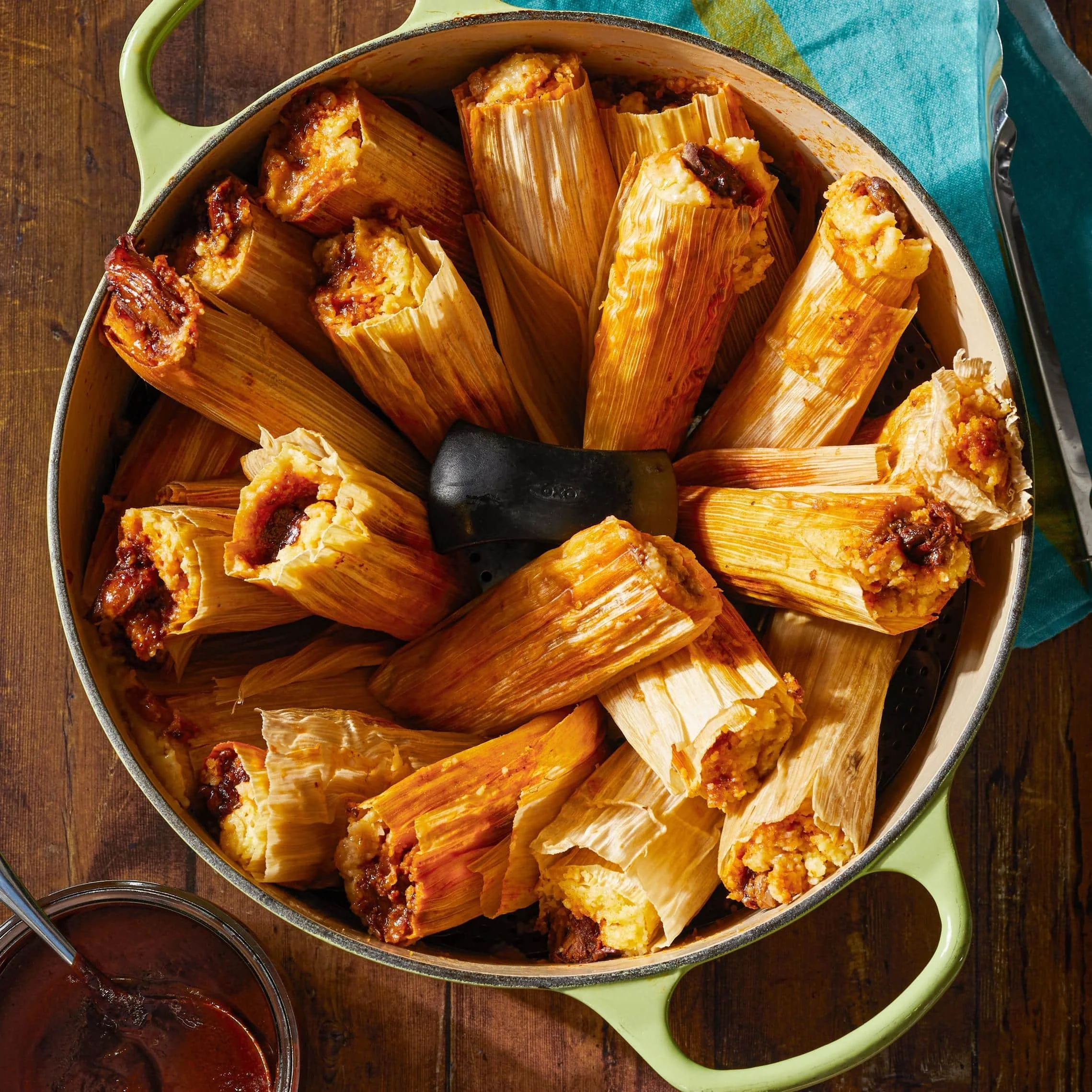
Recipe at a Glance
• Prep time: 1 hour (+ 1 hour soaking corn husks)
• Cook time: 1 hour 15 minutes (steaming)
• Total time: ~2 hours 30 minutes active
• Difficulty: Intermediate
• Yield: 24–28 tamales
• Course: Antojito / Celebration / Main
• Region/Origin: Nationwide; pre-Columbian origins across Mesoamerica
Ingredients
For the Corn Husks
• 1 large package (8 oz / 225 g) dried corn husks (hojas de maíz) — available at Latin grocery stores or online
Soak corn husks in the hottest water your tap will produce for at least 1 hour. Weight them down with a plate to keep them submerged. They should be completely pliable and a deep tan color when ready.
For the Masa (Dough)
• 4 cups (480 g) masa harina (Maseca is the most widely available brand in the U.S.)
• 2 cups (450 g) fresh lard, at room temperature — or vegetable shortening
• 3–3½ cups (720–840 ml) warm chicken or vegetable broth
• 1½ teaspoons (6 g) baking powder
• 1½ teaspoons (7 g) kosher salt
The floating-ball test: A properly made tamale masa is aerated enough that a small ball (the size of a grape) will float when dropped in a glass of cold water. This is the traditional quality check. If it sinks, beat the lard longer. Do not skip this test.
Substitution: Fresh masa (masa preparada) from a Latin tortillería is superior to masa harina — it saves a step and produces a more tender tamal. If you have a tortillería nearby, buy it there. Ask for plain masa for tamales (not for tortillas — it’s a different grind).
For the Red Chile Pork Filling (Classic)
• 2 lbs (900 g) pork shoulder (butt), cut into 2-inch chunks
• 4 dried guajillo chiles, stems and seeds removed
• 2 dried ancho chiles, stems and seeds removed
• 3 garlic cloves
• 1 teaspoon (2 g) cumin
• 1 teaspoon (1 g) dried Mexican oregano
• 2 bay leaves
• Salt to taste
Braise the pork in water or broth with the bay leaves, half an onion, and garlic until completely tender and shreddable (about 1.5–2 hours on the stovetop or 45 minutes in a pressure cooker). Reserve the braising liquid — use it in the masa and the chile sauce.
For a Vegetarian Filling Option (Rajas con Queso)
• 4 roasted and peeled poblano chiles, cut into strips (rajas)
• 1½ cups (170 g) Oaxacan string cheese (quesillo) or Monterey Jack, shredded
This is a fully traditional filling, not a compromise — rajas con queso tamales are beloved across Mexico.
We offer catering services in and around Austin, TX and Texas Hill Country. Inquire HERE.
Step-by-Step Instructions
1. Soak the corn husks. Cover dried husks in the hottest water your tap produces. Use a plate or bowl to weight them down. Soak a minimum of 1 hour. When ready, husks should be completely soft, pliable, and deep tan in color. Sort through and select the widest, most intact husks for spreading; save small or torn ones for plugging the bottoms of the pot.
2. Braise and shred the pork. Place pork shoulder chunks in a large pot with cold water, 2 bay leaves, half an onion, and 4 smashed garlic cloves. Bring to a boil, skim any foam that rises. Reduce heat and simmer 1.5–2 hours until the pork is completely tender and shreds easily with a fork. Remove pork, shred into rough pieces. Reserve 2 cups of the braising liquid.
3. Make the red chile sauce. Toast guajillo and ancho chiles in a dry skillet 30 seconds per side. Soak in hot water 15 minutes. Blend with 3 garlic cloves, cumin, oregano, salt, and 1 cup reserved pork braising liquid until smooth. Strain through a fine-mesh sieve. In a skillet with 1 tablespoon lard, fry the chile sauce over medium-high heat, stirring constantly, 5–7 minutes until it darkens and thickens. Combine with the shredded pork, taste for salt.
4. Beat the masa. Beat the lard or shortening with a stand mixer or hand mixer on high speed for 3–4 minutes until very fluffy, pale, and airy — it should look almost whipped. Combine masa harina with baking powder and salt. With the mixer on low, add the masa harina mixture to the lard gradually, alternating with pours of warm broth. Beat until you have a soft, pliable, slightly sticky dough — the consistency of thick peanut butter. Perform the float test: drop a marble-sized ball into cold water. If it floats, your masa is ready. If it sinks, beat on high speed 2 more minutes and test again.
5. Set up your assembly station. Arrange in front of you: the bowl of soaked husks (drain excess water), the bowl of masa, the bowl of filling, and a large steamer pot filled with 2–3 inches of water, with a steamer rack inside lined with a layer of corn husks (or a layer of wet corn husks laid flat to form a bed).
6. Spread the masa. Hold a soaked corn husk with the wide end toward you. Using a spreader, the back of a wide spoon, or your palm, spread a ¼-inch (6 mm) layer of masa in a rectangle on the center-upper portion of the husk. Leave a 1-inch (2.5 cm) border on the sides and a 3-inch (7.5 cm) border at the pointed bottom. The masa layer should cover roughly two-thirds of the husk.
7. Add the filling. Place 2–3 tablespoons of filling in a line down the center of the masa. The most common beginner error is overfilling — a modest line of filling is correct. Overfilling causes the tamal to burst open or fail to seal.
8. Fold and close. Fold one long side of the husk over so the masa edges meet and fully encase the filling. Fold the other long side over the top. Fold the narrow, pointed bottom end up toward the filling. Stand the tamal upright, open end up, in the steamer pot. Lean tamales against each other for support; they should be snug but not crushed.
9. Steam. Place the steamer pot over high heat and bring to a boil. Once steaming vigorously, reduce heat to maintain a steady, active steam. Cover tightly with a lid. Steam 1 hour 15 minutes. The pot should be hissing steadily with steam and the kitchen will fill with the unmistakable, deeply comforting smell of cooked masa and chile. Check the water level every 20–25 minutes — add boiling water as needed to keep it at 2 inches. Do not let the pot run dry.
10. Test for doneness. A tamal is done when the corn husk peels away cleanly from the masa without sticking. If the masa sticks, re-cover and steam 10–15 more minutes. Let tamales rest in the pot, uncovered, for 5–10 minutes after steaming — they firm up as they cool slightly.







Critical Technique Tips
• The float test saves everything. If your masa ball sinks, it means the fat isn’t properly incorporated and your tamales will be dense. Beat longer, add a touch more broth if needed.
• Stand tamales upright, open end up. Steam rises into the open top and cooks the tamal from the inside. Horizontal or upside-down tamales cook unevenly.
• Make more than you think you need. Tamales freeze beautifully — raw or cooked — for up to 3 months. Steam frozen tamales directly from frozen (no thawing needed) for 30 minutes.
Tips, Variations & Substitutions
Texas Sourcing
Dried corn husks (hojas de maíz) and masa harina (Maseca) are stocked at virtually every H-E-B in Texas, usually in the Latin foods aisle or the baking section. If you’re in the Austin or San Antonio area, Latin grocery stores and tortillerías often sell fresh masa preparada specifically for tamales — ask at the counter. Central Market also carries dried chiles, lard (manteca), and Oaxacan string cheese (quesillo) if you want to make the full spread from scratch.
Regional Variations
• Oaxacan tamales: Wrapped in banana leaves instead of corn husks — the leaves impart a subtle grassy, herbal fragrance that changes the entire character of the tamal. Masa is often enriched with mole negro.
• Zacahuil (Veracruz/Huastec): Enormous tamales cooked in banana leaves in a wood-fired pit — sometimes feeding entire communities. Not home-kitchen scale, but worth knowing.
• Sweet tamales (tamales de dulce): Pink-tinted masa with raisins, cinnamon, and dried fruit — a Michoacán and Jalisco specialty. Serve with champurrado (thick chocolate masa drink) and watch faces light up.
• Tamales de rajas: Roasted poblano strips and melted cheese — the vegetarian standby that never disappoints.
• Northern Mexico: Some northern styles incorporate a small amount of flour in the masa for a slightly fluffier texture.
Spice Level Adjustments
• Mild: Ancho chiles only, seeds removed; no guajillo.
• Medium: Guajillo + ancho blend with seeds removed.
• Hot: Add 1–2 chiles de árbol to the sauce blend.
Dietary Adaptations
• Vegetarian: Use rajas con queso filling; substitute vegetable broth in the masa.
• Vegan: Replace lard with coconut oil or vegan shortening; use vegetable broth; use a vegan cheese or omit entirely.
• Gluten-free: Masa harina is pure ground dried corn — naturally gluten-free.
How to Serve Tamales
What to drink: The classic tamalada pairing is atole — a warm, thick masa-based drink flavored with chocolate, strawberry, or vanilla — or champurrado, the chocolate-spiced version. Both are traditional and deeply comforting. On Christmas Eve in this house, we also keep a big vitrolero of agua de jamaica on the counter for those who want something cold and bright against the richness of the tamales.
The best way to serve tamales is exactly how they come out of the pot — still in the husk, still steaming.
Traditional accompaniments: - Salsa roja or salsa verde spooned over the tamal once it’s been unwrapped - Crema and queso fresco drizzled on top - Mexican red rice and refried beans alongside - Champurrado (thick Mexican hot chocolate made with masa) at Christmas — the most iconic pairing - Atole (warm masa-based drink in vanilla, guava, or chocolate) as an alternative
Plating and serving notes: - Serve tamales still in the husk on the plate — let each person unwrap their own. It’s part of the ceremony and keeps the tamal hot longer. - At a party or tamalada, pile tamales in a large basket lined with a clean cloth napkin to keep them warm at the table. - A drizzle of your best salsa on the plate before placing the tamal, with a small scoop of refried beans on the side, is all the presentation you need.
The Story Behind Tamales
Few foods can claim a lineage as ancient as the tamal. Wikipedia’s historical entry on tamales cites archaeological evidence dating tamale preparation in Mesoamerica to 8000–5000 BCE — making them among the oldest prepared foods on earth. The Aztec, Maya, Olmec, and Toltec civilizations all relied on tamales as portable, self-contained meals: nourishment for warriors, hunters, pilgrims, and traders. Tamales appear in the Florentine Codex — the 16th-century ethnographic text by Fray Bernardino de Sahagún documenting Aztec life — described with dozens of varieties: sweet, savory, chile-sauced, bean-filled, fruit-stuffed.
As Ventura’s Tamales’ history piece notes, archaeologists Karl Taube, William Saturno, and David Stuart have found pictorial references to tamales in the Mural of San Bartolo in Petén, Guatemala, dating to around 100 CE. The Toltecs are among the oldest confirmed tamale-eaters, with fossilized corn husks found near the Pyramid of the Sun and Pyramid of the Moon at Teotihuacan.
The Spanish conquest changed the filling but not the form. Lard, pork, beef, and raisins entered the tamal through colonial-era trade, enriching what was already a sophisticated food. The corn-masa-and-steam technique — one of humanity’s oldest culinary methods — remains exactly as it was thousands of years ago.
Today, la tamalada — the communal tamale-making gathering — is one of Mexico’s most cherished food traditions, particularly around Christmas Eve and Día de la Candelaria (Candlemas, February 2). By tradition, whoever finds the miniature figurine baked into the Rosca de Reyes (Three Kings cake, eaten January 6) must host a tamalada for the group on February 2. It is the most joyful obligation in Mexican culinary culture, and I am always, always hoping to find the figurine.
Frequently Asked Questions
Why are my tamales sticking to the corn husk — what did I do wrong? Two likely causes: the masa needs more fat, or the tamales need more steam time. If the husk won’t peel away cleanly, re-cover and steam 10–15 more minutes. If the masa itself is sticking (not just clinging), your fat ratio may be off — the next batch, beat the lard longer and check the float test.
How do I know if the masa is the right consistency before spreading? The masa should feel like thick, slightly sticky peanut butter — soft and pliable but not wet or runny. It should hold its shape when you press it with your finger, not collapse into a puddle. And it should pass the float test: a grape-sized ball dropped in cold water should float.
Can I make tamales without lard, and what’s the best substitute? Yes. Vegetable shortening is the most common substitute and produces a very similar result. Refined coconut oil works well and adds a subtle richness. Olive oil can be used but gives a slightly different flavor. The most important thing is that the fat is beaten until fluffy before the masa harina is added — any fat that aerates properly will work.
How do I freeze tamales — raw or cooked? Both work well. For raw tamales (assembled but not yet steamed): freeze in a single layer on a baking sheet until solid, then transfer to freezer bags. Steam from frozen for 1 hour 30 minutes. For cooked tamales: cool completely, freeze the same way. Steam from frozen for 30 minutes. Raw-frozen tamales have a slightly better texture; both are excellent.
What is the difference between corn husk tamales and banana leaf tamales? The husk or leaf is not just a wrapper — it perfumes the masa from the outside in as it steams. Corn husks impart a faint, dry corn fragrance and produce a firmer, slightly drier tamal. Banana leaves impart a grassy, herbal, slightly floral scent and produce a softer, more moist tamal with a different character entirely. Oaxacan tamales in banana leaves are a distinct experience from central Mexican tamales in corn husks.
How many tamales should I plan per person for a party? For a main course with sides (rice, beans, salsa): 3–4 tamales per person. If tamales are the only item and people are hungry: 4–6 per person. For a party snack or appetizer spread: 2 per person. When in doubt, make more — tamales freeze perfectly, so there is no such thing as too many.

If you’ve been told you have prediabetes or type 2 diabetes and you feel overwhelmed, this ebook is for you. Written in clear, everyday language, Taking Charge of Type 2 Diabetes – Simple Choices, Real Results breaks down what your diagnosis really means and how small, realistic changes can lead to better blood sugar, more energy, and real long-term results.
Inside, you’ll learn how food, movement, stress, and sleep affect your blood sugar, with simple frameworks you can actually use in real life – whether you’re cooking at home, eating out, or juggling a busy schedule. You’ll find practical tips, and mindset shifts that help you stay consistent without feeling deprived.
This ebook is designed to feel like a supportive conversation, not a lecture. You can read it in short sections, highlight what speaks to you, and start applying one small change at a time so you build habits that stick. Whether your goal is to prevent complications, support weight loss, or simply feel more in control of your health, this guide gives you the foundation to take the next step with confidence.