

Buñuelos Recipe (Step-by-Step Guide)
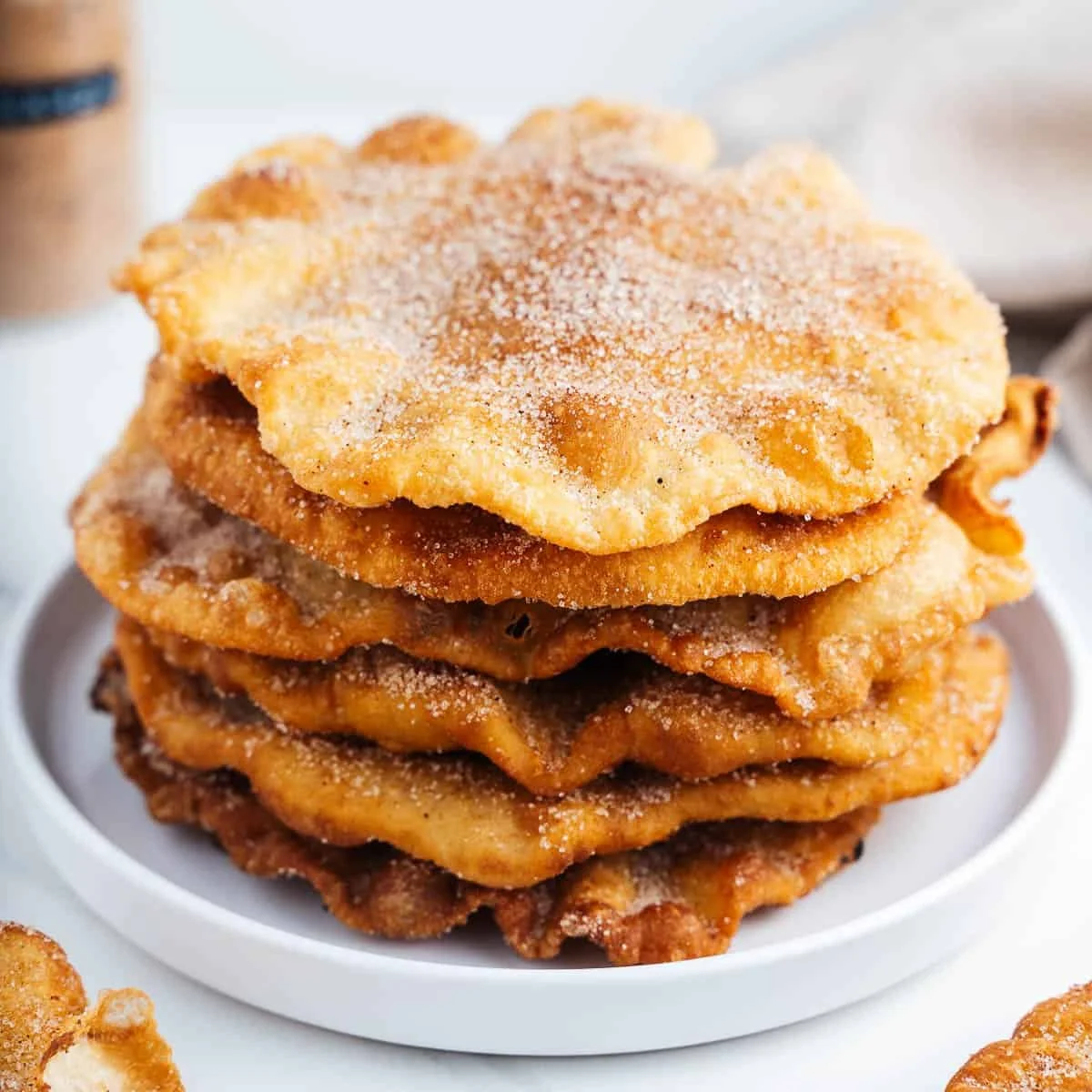
Buñuelos are large, paper-thin crispy fried fritters made from a simple flour dough, fried until golden and blistered, then dusted with cinnamon sugar or drizzled with piloncillo syrup. They are eaten across all of Mexico and much of Latin America and Spain, with deep roots in the Christmas and New Year season. The recipe has just six pantry ingredients, requires no special equipment, and produces something that looks — and sounds — genuinely impressive. Also: they are the crunchiest thing you will ever make in your kitchen. Crunchy food is joyful food.
Don’t be intimidated by the frying. I’ll walk you through every step, including the oil temperature trick that ensures shatteringly crispy buñuelos every single time. Let’s fry.
Recipe at a Glance
• Prep time: 25 minutes (includes 20-minute dough rest)
• Cook time: 20 minutes (frying in batches)
• Total time: ~45 minutes
• Difficulty: Beginner–Intermediate (frying requires attention and a thermometer)
• Yield: 12–16 buñuelos
• Course: Dessert / Street Food / Snack
• Region/Origin: Nationwide Mexico; strong associations with Oaxaca, Jalisco, and central Mexico during the Christmas season
Ingredients
For the Dough
• 2 cups (250 g) all-purpose flour, plus more for rolling
• 1 teaspoon baking powder
• ¼ teaspoon fine salt
• 2 tablespoons granulated sugar
• ½ cup (120 ml) warm water (or anise-infused water — see note below)
• 3 tablespoons vegetable shortening or lard (lard is the more authentic choice — see note)
• 1 large egg (optional — some traditional recipes omit it; it makes the dough richer and easier to handle)
Anise water (the secret ingredient): Simmer 1 teaspoon of whole anise seeds in ½ cup of water for 5 minutes. Strain, cool completely, and use in place of plain warm water. This is the detail that makes homemade buñuelos taste unmistakably Mexican rather than generic fried dough. Do not skip it if you can help it.
For Frying
• Neutral vegetable oil (canola or corn oil) — enough to fill a deep skillet or Dutch oven at least 2 inches deep
For the Topping
Classic cinnamon-sugar version: - ½ cup (100 g) granulated sugar - 1 ½ teaspoons ground cinnamon (Mexican canela is preferred — milder and more aromatic than standard cassia cinnamon)
Oaxacan piloncillo syrup (the more traditional and spectacular option): - 1 cone piloncillo (about 8 oz / 225 g), roughly chopped (substitute: ¾ cup dark brown sugar + ½ teaspoon molasses) - 1 cup (240 ml) water - 1 cinnamon stick - 2 star anise - Optional: 1–2 dried guayaba (guava) or tejocotes, halved
Key Ingredient Notes
• Lard vs. shortening: Lard (manteca) produces the most authentic texture — lighter, more blistered, and with a subtle savory depth that pure shortening doesn’t offer. If your Mexican market sells fresh lard, use it. Shortening is an excellent and practical substitute. Avoid butter: it changes the flavor profile and burns at frying temperatures.
• Piloncillo: This unrefined cane sugar, sold in cones or small blocks at most Latin markets and many mainstream grocery stores, has a deep, caramel-molasses complexity that granulated sugar simply cannot replicate in the syrup. If you’re going Oaxacan style, use it.
We offer catering services in and around Austin, TX and Texas Hill Country. Inquire HERE.
Step-by-Step Instructions
1. Make the anise water (if using). Combine 1 teaspoon of whole anise seeds with ½ cup of water in a small saucepan. Bring to a simmer and cook 5 minutes. Strain out the seeds and let the liquid cool completely to room temperature before adding it to the dough. This takes only minutes but adds a flavor dimension that defines the dish.
2. Mix the dry ingredients. In a large mixing bowl, whisk together the flour, baking powder, salt, and granulated sugar until well combined — the mixture should smell clean and faintly sweet from the sugar.
3. Cut in the fat. Add the shortening or lard to the flour mixture. Using your fingertips, work the fat into the flour by rubbing and pressing until the mixture resembles coarse, pea-sized crumbs. This step creates the flaky, tender structure that allows the buñuelo to puff and blister in the oil.
4. Form the dough. Add the egg (if using) and slowly add the anise water (or plain warm water), a tablespoon at a time, stirring with a fork. You may not need all of the water — add just enough to bring the dough together into a smooth, slightly tacky ball. Do not overwork it. If it sticks to your hands, add flour one tablespoon at a time. If it crumbles apart, add water a teaspoon at a time.
5. Rest the dough — this step is not optional. Cover the dough ball with a clean kitchen towel and let it rest at room temperature for at least 20 minutes (up to 1 hour is fine). This relaxes the gluten, which is what allows you to roll the dough paper-thin without it snapping back like a rubber band. Skipping this rest = frustrating rolling = thick buñuelos.
6. Make the piloncillo syrup (if using), while the dough rests. Combine the chopped piloncillo, water, cinnamon stick, star anise, and any dried fruit in a small saucepan. Bring to a boil, stirring until the piloncillo dissolves. Reduce heat and simmer 10–15 minutes until the syrup has thickened slightly — it should coat the back of a spoon. Keep warm over very low heat until ready to serve.
7. Divide and roll the dough. Divide the rested dough into 12–16 equal balls. On a lightly floured surface, use a rolling pin to roll each ball as thin as you possibly can — you are aiming for translucent, near paper-thin discs about 10–12 inches across (dinner-plate size). You should almost be able to see your hand through the dough when you hold it up to the light. This is the single most important step for achieving the shatteringly crispy texture.
8. Heat the oil. In a deep 12-inch skillet or Dutch oven, heat 2 inches of vegetable oil to 350–360°F (175–182°C). Use a deep-fry or instant-read thermometer — this step matters more than most people realize. Too cool and the buñuelos absorb oil and turn greasy and leathery. Too hot and they burn before crisping through. The target range is your friend. Visual check without a thermometer: Drop a small pea-sized piece of dough into the oil. If it sinks, sizzles vigorously, and rises to the surface within 2–3 seconds, the temperature is right.
9. Fry one at a time. Carefully lower a dough circle into the hot oil — it will puff and blister almost immediately. Use long tongs or a spider (a wide mesh skimmer) to gently hold it flat if it starts to fold. Fry 30–45 seconds per side until pale golden — it should look like a blistered, golden sun. Do not wait for deep browning; buñuelos should be a light gold, not amber.
10. Drain and top immediately. Remove each buñuelo to a paper-towel-lined baking sheet or a wire rack. While still hot, dust generously with the cinnamon-sugar mixture — shake it over the whole surface like you mean it; it should sizzle very faintly against the hot surface and smell of warm canela. Alternatively, transfer to a plate and drizzle with the warm piloncillo syrup.
11. Work in an assembly line and serve promptly. Roll the next buñuelo while one is frying. Keep them moving. Buñuelos are at their absolute best within 20–30 minutes of frying, while the crunch is still sharp. If you need to hold them briefly, arrange on a wire rack (not stacked) in a low oven at 200°F. Store any leftovers uncovered at room temperature — covering them traps steam and destroys the crunch. ### Critical Technique Tips - The thinner the dough, the crispier the buñuelo. If yours come out chewy rather than crispy, you didn’t roll them thin enough. Each time you make them, push the rolling a little further.
• Maintain oil temperature throughout. The temperature drops after each buñuelo goes in — let the oil return to 350°F between batches.
• Assembly line is essential. Don’t roll all the dough first and let it sit — the discs will dry out and become brittle. Roll, fry, repeat.
Tips, Variations & Substitutions
Regional Variations
• Buñuelos Oaxaqueños: The most celebrated regional variety. Slightly thicker than the paper-thin style and almost always served broken into rustic shards, floating in warm piloncillo-canela syrup with guayaba or tejocotes — a deeply warming, almost soup-like dessert. In Oaxaca City, it is traditional to smash your clay plate on the ground after eating your buñuelo and make a wish for the New Year. Broken shards of pottery collect in the streets of the Zócalo on New Year’s Eve. This tradition is one of the most charming food rituals in all of Mexican culture, and worth knowing if you’re serving the Oaxacan style to guests.
• Buñuelos de viento (wind fritters): An airier, lace-thin variety made with a choux-like batter rather than a rolled dough — extremely delicate, almost translucent, popular in Jalisco and Colima. This is an advanced technique and a different recipe altogether, but worth exploring.
• Buñuelos de rodilla: A northern style where the dough is stretched directly over the baker’s knee (rodilla) to achieve extreme, uniform thinness. A traditional skill that takes practice.
• Texas and border state variation: Along the Texas-Mexico border and in many Texas families, buñuelos are made year-round as a simple everyday treat, not just at Christmas — dusted with cinnamon sugar and enjoyed with coffee any time the mood strikes.
Texas Sourcing
Piloncillo (unrefined cane sugar) is stocked at virtually every H-E-B in Texas in the Hispanic foods aisle, usually sold in brown cones near the dried chiles. Fresh lard (manteca) is available at Latin markets and many H-E-B Plus locations — far superior to shortening for the most authentic, blistered buñuelos. Mexican cinnamon (canela) is in the spice aisle at H-E-B or at any Latin grocery store.
Dietary Adaptations
• Vegan: Omit the egg entirely — the dough works fine without it, just slightly less rich. Use vegetable shortening instead of lard.
• Gluten-free: A 1:1 gluten-free all-purpose flour blend works with moderate success. The dough will be more fragile and harder to roll paper-thin without tearing; handle gently and roll between sheets of parchment paper.
Serving Suggestions
What to drink: In Mexico, buñuelos are classically served alongside ponche — a warm Christmas fruit punch made with guava, tejocote, tamarind, and piloncillo. In my Hill Country kitchen I serve them with café de olla or atole de guayaba. Both are warming, lightly sweet, and let the crispy dough shine.
The simplest and most universally beloved presentation is the classic: a generous dusting of cinnamon-sugar over a hot, just-fried buñuelo. That’s it. That’s the tradition.
For the Oaxacan style, break one or two buñuelos into large rustic shards in a wide shallow bowl and ladle warm piloncillo syrup over everything — elegant and completely homey at once. Add a broken guayaba half to the bowl for the real deal.
The ultimate Mexican Christmas pairing: buñuelos with champurrado (thick, corn-masa-thickened hot chocolate) or atole (a warm, masa-based hot drink flavored with vanilla or fruit). The combination of shatteringly crispy fried dough dunked into thick, warm chocolate is one of the great pleasures of December in a Mexican household.
For a platter presentation, pile buñuelos generously on a large wooden board or a piece of colorful Mexican pottery, dust with an extra cloud of cinnamon sugar, and let people break off pieces. Edible flowers, a light shower of powdered sugar, or a small cinnamon stick as garnish all photograph beautifully for the holidays.
Cultural & Historical Notes
Buñuelos have a history that stretches far beyond Mexico — and farther back than most people expect. According to WLRN’s deep dive into buñuelo history, food historians trace them to the Moors — the Muslim Arabs who ruled medieval Spain for eight centuries. The story goes that during a siege of Seville in the 11th century, oven fuels became scarce, prompting a baker to fry dough in oil instead. The word “buñuelo” itself is believed to derive from puño, the Spanish word for fist — describing the way the dough was pounded or shaped.
Tasting Table confirms that buñuelos have roots in Moorish Spain and were brought to Latin America by Spanish colonizers, where each region adapted them using local ingredients — root vegetables in Cuba and Nicaragua, piloncillo and canela in Mexico. This makes buñuelos a beautiful example of Moorish, Spanish, and indigenous Mexican culinary traditions converging in a single dish.
When Spanish colonizers arrived in Mexico, they brought their frying technique with them, and Mexican cooks brilliantly adapted it — incorporating piloncillo, native canela (Mexican cinnamon, a different and more delicate variety than cassia), and anise, while stretching the dough to a translucency that the Spanish originals never achieved. The result is uniquely Mexican, even though its ancestry spans continents.
In Mexico today, buñuelos are inseparable from the Christmas season — specifically from posadas (the nine nights of festivities from December 16–24 commemorating Mary and Joseph’s search for shelter), Nochebuena (Christmas Eve), and New Year’s Eve. They are also prominently associated with the Feast of the Virgin of Guadalupe on December 12th. As Nibbles and Feasts notes, the posadas tradition itself stretches back over 400 years, and buñuelos have been part of it virtually from the beginning — sold at street stalls outside churches, eaten by candlelight, shared with neighbors. The sound of one cracking is the sound of the season.
Frequently Asked Questions
Why are my buñuelos chewy instead of crispy? The two most common causes are dough that wasn’t rolled thin enough, and oil that was too cool. For crispiness, you need the dough to be nearly translucent when held up to light, and the oil to be at a solid 350–360°F. If your oil is below 325°F, the buñuelos will absorb oil instead of crisping up. Use a thermometer and roll even thinner next time.
Can I make buñuelo dough ahead of time and refrigerate it overnight? Yes — the dough actually rests and relaxes very well in the refrigerator. After forming the dough ball, wrap it tightly in plastic wrap and refrigerate for up to 24 hours. Let it come to room temperature for 30 minutes before rolling. The rested dough will be wonderfully pliable.
What is the difference between buñuelos and sopapillas? Both are fried doughs, but they are quite different. Sopapillas (common in New Mexico and some Tex-Mex restaurants) are small, puffy pillows of yeasted or leavened dough that puff up dramatically when fried. Mexican buñuelos are unleavened (or minimally leavened), paper-thin, and large — they blister and crisp rather than puff. They share a lineage but are distinct dishes with different textures, flavors, and eating experiences.
How do I make the Oaxacan piloncillo syrup for buñuelos? Combine one roughly chopped cone of piloncillo (about 8 oz) with 1 cup of water, 1 cinnamon stick, and 2 star anise in a small saucepan. Bring to a boil, stirring until piloncillo dissolves. Reduce heat and simmer 10–15 minutes until the syrup coats the back of a spoon. Add halved dried guayaba or tejocotes for the full Oaxacan version. Keep warm over very low heat and ladle over broken buñuelo shards in shallow bowls.
Can I bake buñuelos instead of frying them? You can brush the rolled-out dough discs lightly with oil and bake at 425°F for 8–10 minutes until crispy and golden — they will not achieve the same blistered, layered texture as fried buñuelos, but they are still quite enjoyable and significantly less hands-on. Think of them as the lighter, weeknight version.
How do I store leftover buñuelos without them getting soggy? Store them uncovered (or loosely covered with a clean towel) at room temperature on a wire rack — never in an airtight container or wrapped tightly. The sealed air traps residual steam and destroys the crunch within an hour. If they’ve gone soft by the next day, a 5-minute stint in a 350°F oven usually revives much of their crispiness.