

Capirotada Recipe (Step-by-Step Guide)
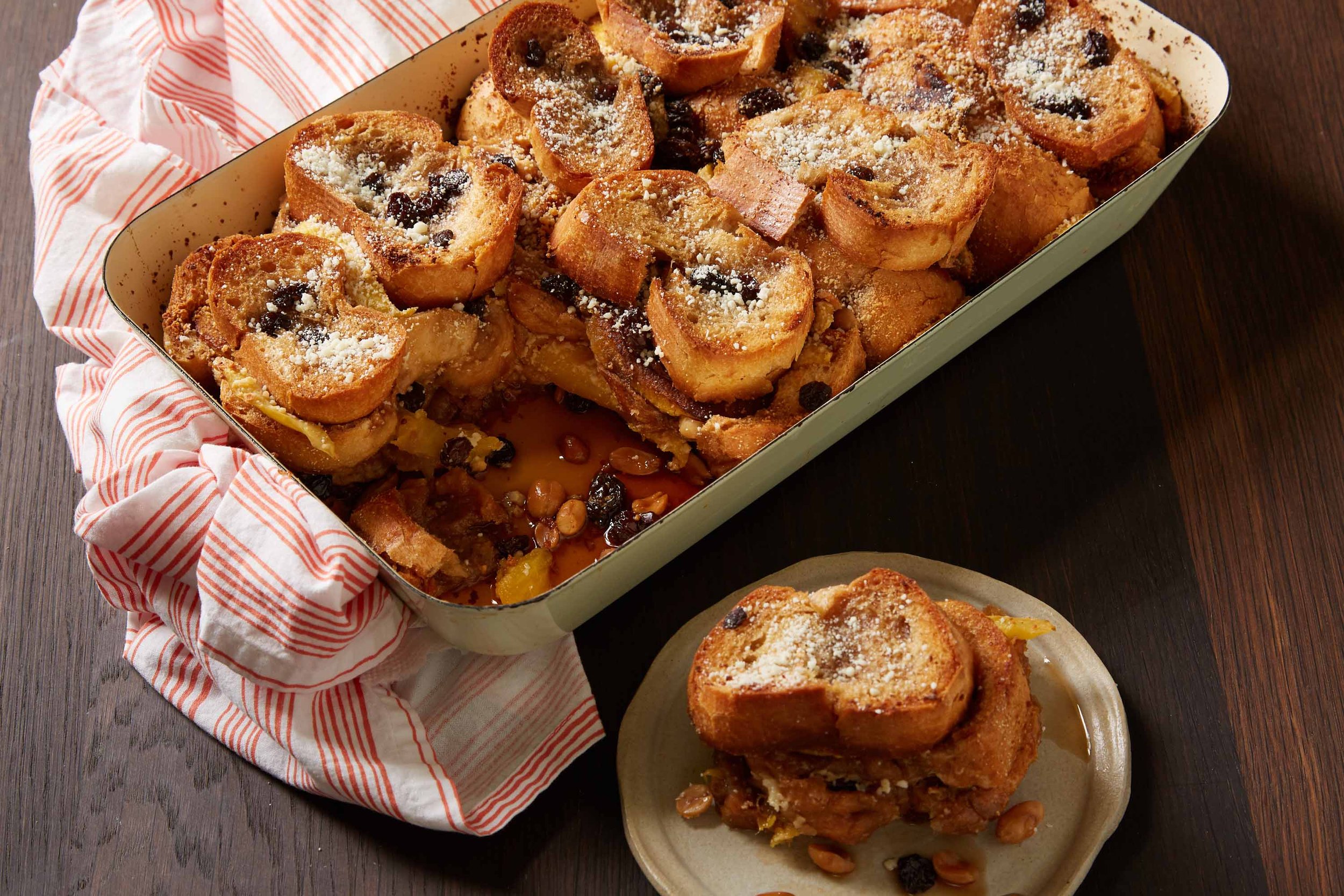
Capirotada (pronounced cah-pee-ro-TAH-dah) is Mexico’s Lenten bread pudding, and it is unlike any bread pudding you have encountered before. It is built from stale bolillo rolls, soaked in a spiced piloncillo syrup, layered with raisins, nuts, dried fruits, and — the detail that stops everyone cold the first time they hear it — melted cheese. Yes, cheese. Not cream cheese, not mascarpone, but salty, stretchy Mexican cheese, melted directly into the sweet syrup-soaked bread. The combination sounds improbable. It is, in fact, magnificent — the salt cutting through the sweet, the cheese creating a richness that no amount of butter could replicate.
This is one of the most symbolically loaded dishes in all of Mexican cuisine. Each ingredient in the traditional recipe carries a meaning tied to the passion of Christ and the Lenten season: the bread represents the Body of Christ, the dark piloncillo syrup represents His blood, the cloves represent the nails of the crucifixion, the cinnamon sticks the wood of the cross, and the melted cheese the Holy Shroud. Eating capirotada is not casual. It is an act of remembrance, however unconsciously, for the many families who make it every Lent.
Key Details
• Prep time: 20 minutes
• Cook time: 1 hour 20 minutes (including syrup steeping time)
• Total time: About 2.5 hours (including cooling/resting)
• Difficulty: Easy–Intermediate
• Yield: 8–10 servings
• Course: Dessert / Lenten tradition
• Region/Origin: Nationwide Mexico; particularly strong tradition in northern Mexico and along the Texas-Mexico border
Ingredients
For the Piloncillo Syrup
• 12 oz (340g) piloncillo, roughly broken into pieces (or 1½ cups packed dark brown sugar)
• 4½ cups (1.1L) water
• 4 cinnamon sticks (canela, Mexican cinnamon — thinner and softer than Vietnamese or Ceylon)
• 6 whole cloves
• 2 star anise (optional; adds a lovely warmth)
Substitution note:Piloncillo is unrefined Mexican cane sugar, sold in solid cones or blocks. It has a complex, molasses-forward flavor that brown sugar cannot perfectly replicate but approximates adequately. Find piloncillo at every H-E-B in Texas (in the Latin baking aisle), Central Market, and any Latin market. Canela (Mexican cinnamon, also called Ceylon cinnamon) is softer and more fragrant than the hard Vietnamese or Saigon cinnamon sold in most U.S. spice aisles. Central Market and H-E-B both carry it, labeled as Mexican cinnamon.
For the Bread Layer
• 4–5 bolillo rolls (day-old or slightly stale), sliced ½ inch thick
• 4 tbsp (55g) unsalted butter, softened, for spreading
Substitution note:Bolillos are crusty Mexican sandwich rolls available at H-E-B bakeries, most Latin markets, and many Texas panadería bakeries. Day-old bolillos are ideal — they absorb the syrup better without falling apart. French bread or a crusty Italian loaf cut into slices works as a substitute.
For the Layers
• 1 cup (150g) raisins
• ½ cup (55g) chopped pecans or peanuts (pecans are a Texas twist that works beautifully)
• ½ cup (50g) slivered almonds
• ½ cup (85g) dried fruit (chopped dates, prunes, or dried apricots), optional
• ½ cup (80g) shredded or thinly sliced queso asadero, Longhorn cheddar, or Monterey Jack
Substitution note: The cheese is non-negotiable for a traditional capirotada — but the variety varies wildly by region and family. In northern Mexico and along the Texas border, salty Longhorn cheddar or Colby is traditional, playing up the sweet-salty contrast. In central and southern Mexico, a mild white cheese like queso asadero is more common. Mozzarella melts well and is a perfectly good substitute. Use what you love.
We offer catering services in and around Austin, TX and Texas Hill Country. Inquire HERE.
Step-by-Step Instructions
1. Dry and toast the bread. Preheat your oven to 350°F (175°C). Spread butter lightly on both sides of each bolillo slice. Arrange in a single layer on a baking sheet. Bake for 3 minutes per side, until the bread is lightly golden and very dry — almost crouton-like. The dryness is critical; the slices need to be dry enough to absorb the syrup without immediately dissolving. Remove from oven and let cool. Keep the oven on.
2. Make the piloncillo syrup. Combine the piloncillo (or brown sugar), water, cinnamon sticks, cloves, and star anise in a large saucepan. Bring to a boil over medium-high heat, stirring to help the piloncillo dissolve. Once boiling, reduce heat and simmer uncovered for 20 minutes. The syrup should turn a deep amber color and smell of cinnamon, clove, and warm sugar — like the sweetest version of mulled wine. Remove from heat, cover, and steep for 2 hours if time allows (30 minutes minimum). Strain through a fine-mesh sieve and discard solids.
3. Layer the capirotada. Grease a 9x13 inch baking dish with a little butter. Arrange a single layer of toasted bolillo slices on the bottom, fitting them snugly. Scatter a portion of the raisins, pecans, almonds, dried fruit if using, and cheese over the bread layer. Add another layer of bread slices. Repeat the layering — fruit, nuts, cheese — until you’ve used all the bread. End with the fruit-nut-cheese layer on top.
4. Add the syrup. Slowly and evenly pour the warm piloncillo syrup over the entire assembled capirotada. Pour it gradually, giving the bread time to absorb it — don’t flood it all at once. You want the bread saturated, not swimming. Press gently with the back of a spoon to encourage absorption. Let it sit for 10 minutes before baking; the bread will swell and the syrup will begin to soak through.
5. Bake. Cover the baking dish tightly with foil. Bake at 350°F for 30 minutes. Remove the foil and bake an additional 15 minutes uncovered, until the top is slightly caramelized and the edges are bubbling. The capirotada should look dark, glistening, and slightly set — like a very moist bread pudding. The cheese on top will have melted into golden, slightly browned patches.
6. Rest and serve. Remove from the oven and let rest for at least 15 minutes before serving. The texture firms up significantly as it cools. Capirotada can be served warm, at room temperature, or cold from the refrigerator — and remarkably, it is wonderful in all three states, each producing a slightly different character. Serve in squares, scooped with a large spoon.

Tips, Variations & Substitutions
Regional variations across Mexico
The diversity of capirotada recipes across Mexico is staggering, and almost every family believes their version is the correct one. - Northern Mexico / Texas border style: Longhorn cheddar, peanuts, raisins, and a piloncillo-only syrup (no milk). Bolder, saltier, more dramatic sweet-salty contrast. - Central Mexico style: Queso asadero or queso fresco, almonds, pecans, sometimes fresh banana slices, piloncillo syrup. - Capirotada de leche: A milk- or condensed-milk-enriched version popular in Jalisco and Sinaloa. Add 1 cup of warm whole milk to the syrup before pouring over the bread. The result is creamier and softer. - With sprinkles: In some regions, especially for festive versions served at Christmas, colored sprinkles (chochitos) are scattered on top before baking. This is cheerful and correct.
Cheese selection
Use a cheese that melts well and has some salt content. Mild Longhorn cheddar, Colby, Monterey Jack, low-moisture mozzarella, queso asadero, and queso Oaxaca all work. The cheese shouldn’t be the dominant flavor — it’s there to add richness and a salty counterpoint.
Make-ahead
Capirotada is an excellent make-ahead dessert. Assemble completely (through step 4), cover, and refrigerate overnight. Bring to room temperature for 30 minutes before baking. It also keeps beautifully in the refrigerator for up to 5 days and actually improves on day two, once the syrup has fully penetrated the bread.



Where to find ingredients in Texas
• Piloncillo: H-E-B (Latin baking aisle), every Latin market in Texas, Central Market.
• Bolillos: H-E-B bakeries make fresh bolillos daily. Ask for “day-old” bolillos or buy them the day before you plan to make capirotada — the dryness is essential.
• Mexican cinnamon (canela): Central Market, H-E-B spice aisle (look for the labeled “Mexican cinnamon” or “canela”), any Latin market.
• Queso asadero: H-E-B and Central Market carry it. Cacique brand is reliable.
How to Serve Capirotada
Capirotada is traditionally served during Lent — on Fridays and during Holy Week, when meat is not eaten. It functions as both dessert and a substantial meatless dish, and it’s eaten at room temperature or slightly warm throughout the day. In many households, a large pan of capirotada sits on the counter on Good Friday, and family members cut a piece whenever they want.
Traditional accompaniments: - Café de olla — cinnamon-spiced Mexican black coffee, the classic pairing; the coffee’s bitterness is the perfect foil for the sweet, spiced pudding - Warm whole milk, poured alongside for children - A small glass of rompope (Mexican eggnog liqueur) for adults who want something festive during the Lenten period - Atole (warm corn-based masa drink flavored with chocolate or cinnamon) for a traditional Lenten breakfast pairing
What to drink:Café de olla is the quintessential match — its bitter, cinnamon-spiced depth cuts right through the sweetness of the syrup-soaked bread. For something spirited, a small glass of rompope served slightly chilled is festive, rich, and perfectly in keeping with the Lenten celebration.
Plating note: Capirotada doesn’t need embellishment. A clean square scooped onto a plate, with visible layers of dark bread, raisins, and melted cheese, is its own beautiful presentation. A light dusting of cinnamon on top is all the garnish it needs.
The Story Behind Capirotada
Capirotada has one of the longest and most fascinating origin stories of any dish in Mexican cuisine — spanning Roman antiquity, medieval Spain, the Spanish Inquisition, and five centuries of evolution in the New World.
According to Wikipedia’s detailed entry on capirotada, the dish’s oldest ancestor is the Roman sala cattabia, a stale-bread-and-layered-ingredient preparation documented in the 4th-century cookbook De re coquinaria. Medieval European cooks inherited and transformed this bread pudding tradition across centuries. The word capirotada itself derives from capirote — the tall, cone-shaped hood associated with Spanish religious ceremonies — though the exact linguistic connection remains debated by scholars. The first documented appearance of the name in print was in 1611, in a cookbook by Francisco Martínez Motiño, chef to King Philip II of Spain, where it described a savory dish containing pork, bread, and cheese.
When Spanish conquistadores brought Catholicism and European foodways to the Americas in the 16th century, they brought capirotada with them. Records from the Holy Office of the Spanish Inquisition in the 1640s document recipes for capirotada in New Spain, noting it as a Lenten dish. In Mexico, the recipe collided with indigenous Aztec traditions: the Aztecs had their own practice of soaking stale bread in anise tea, and they used piloncillo (unrefined cane sugar) and canela (Mexican cinnamon) rather than the savory broth of the Spanish version. Over generations, the dish transformed from a savory Spanish strata into the sweet, spiced bread pudding that Mexican families make today.
The symbolic layer — each ingredient representing a component of Christ’s passion — is believed to have developed in colonial Mexico as the dish became a Lenten staple, its ingredients acquiring religious meaning within Catholic devotional practice. As Muy Bueno blogger Yvette Marquez-Sharpnack writes from her El Paso family tradition, “It wasn’t just dessert — it was tradition, reflection, and family all layered into one humble baking dish.” That framing captures something true about capirotada: it is not merely food. It is an annual ritual, a communal act, and a living piece of culinary history that stretches back further than most people know.
Frequently Asked Questions
Why does capirotada have cheese in it? The cheese in capirotada is traditional across most of Mexico, though the type varies enormously. The sweet-salty contrast is the point — the salty, melting cheese cuts through the sweetness of the piloncillo syrup in a way that is genuinely thrilling once you taste it. Don’t skip it on principle; try it first.
What is piloncillo and can I substitute brown sugar?Piloncillo is unrefined, pressed cane sugar with a deep molasses-forward, slightly smoky flavor. Dark brown sugar is the most accessible substitute and produces a good result, though without the full complexity of piloncillo. Find piloncillo at any H-E-B in Texas — it’s in the Latin baking section, sold in cone shapes.
Is capirotada served hot or cold? Both, depending on the family and region. Many people prefer it warm from the oven. By the next day (eaten cold from the refrigerator), the bread has absorbed all the syrup and the texture is denser and more unified — some people prefer this version. Try it both ways.
When is capirotada eaten? Primarily during Lent — on Fridays and throughout Holy Week (the week before Easter). Many families also make it for Christmas. It can technically be eaten year-round but carries its fullest meaning during the Lenten season.
What is the difference between capirotada de agua and capirotada de leche?Capirotada de agua (water-based) uses only the piloncillo-and-water syrup, producing a firmer, more intensely spiced result. Capirotada de leche adds milk or sweetened condensed milk to the syrup, creating a creamier, softer pudding. The water version is more common in northern Mexico; the milk version is popular in Jalisco and Sinaloa.
Does capirotada have alcohol in it? Traditional capirotada does not. Some modern versions add a splash of rum, brandy, or rompope (Mexican eggnog liqueur) to the syrup, which is delicious but not required.
Can I make capirotada without nuts for allergy reasons? Absolutely. Many families make nut-free versions using only raisins, dried fruit, and cheese. The dish is still excellent without nuts — the piloncillo syrup is the backbone of the flavor.
Why is capirotada associated with Lent specifically? Lent requires Catholics to abstain from meat on Fridays and during Holy Week. Capirotada is meatless and filling, making it a practical and spiritually meaningful Lenten dish. The symbolic assignment of religious meaning to each ingredient deepened its connection to the season over centuries of devotional practice in Mexico.

If you’ve been told you have prediabetes or type 2 diabetes and you feel overwhelmed, this ebook is for you. Written in clear, everyday language, Taking Charge of Type 2 Diabetes – Simple Choices, Real Results breaks down what your diagnosis really means and how small, realistic changes can lead to better blood sugar, more energy, and real long-term results.
Inside, you’ll learn how food, movement, stress, and sleep affect your blood sugar, with simple frameworks you can actually use in real life – whether you’re cooking at home, eating out, or juggling a busy schedule. You’ll find practical tips, and mindset shifts that help you stay consistent without feeling deprived.
This ebook is designed to feel like a supportive conversation, not a lecture. You can read it in short sections, highlight what speaks to you, and start applying one small change at a time so you build habits that stick. Whether your goal is to prevent complications, support weight loss, or simply feel more in control of your health, this guide gives you the foundation to take the next step with confidence.